International Sunbelt Social Network Conference XXIII.
12-16. February
2003, Cancun, Quintana Roo, Mexico
Agnes UTASI:
Changes in family structure and solidarity in
Hungary-
(Comparison of ISSP Social Network data 1986-2001)
University of
Szeged Department of Soicology
Correspondence:
Institute for Political Science of the
Hungarian Academy of Sciences
H.1399 Budapest,
Országház u. 30.
Tel:
(361)311-1420/ e-mail: UTASI@MTAPTI.HU
I.
Theoretical frmae of Social Integration and Solidarity
From the
perspective of social stratification, we can speak of integration only if
society is not divided into extremely privileged and non-privileged strata. It
means that full integration can not exist in a society characterized by inequities.
As a consequence, integration can be defined as the rate of inequity which is
acceptable and respectable by the majority and also tolerated by the social
outcast.
Integration and Solidarity are
considered as different dimensions of the same phenomenon. Integration can be
regarded as the ideology, value-content of this phenomenon, while solidarity is
the practical side of it. Integration comes into existence and keeps on living
with the help of solidarity.
II. Two Levels of Social Solidarity
a)
Macro-social solidarity can be defined as solidarity driven by institutions. Main purpose of this solidarity is to
decrease the degree of inequities between social strata in order to preserve
the integrity and stability of the social system.
b)
Micro-social solidarity refers to aids with which small communities help their members in need
altruistically in order to protect these people from falling behind and in
other cases to reach a higher standard of living by exchange of goods. These
aids and transfers rely on trust and work within the network of strong
relationships.
III.
Conditions of Micro-social
a)
Altruism and/or deferred
reciprocity
b)
Trust
c) "Love-relations" and/or
interest-relations
IV. Questions About How
Micro-social Solidarity Works in the Newly Established Hungarian Market Economy
1.
Question
What
effects had market economy on the intensity of solidarity within small
communities and families? New economic problems of market economy can generate
solidarity within poor families and well-of people might show solidarity due to
a possibility of a beneficial concentration of the family capital. On the other
hand, people in the new market economy have more chance to reach individual
well-being, and this selfish pursuit of enrichment might result in the
disintegration of family as solidarity towards hangers-back of the community is
weakening.
Empirical conclusions
Family
solidarity, altruistic exchange of goods did not disappear, it can be confirmed
that altruistic aid between family members still exist in case of need. (see
Table )
2. Question
Which
mechanism drives family related solidarity? Altruism and self-forgetfulness or
market-natured reciprocity based on trust can be regarded as the main driver of
transfers within the family?
Empirical
conclusions
a) The
ratio between giving and receiving goods shows that in everyday life wealthy
people help their relatives in need more often than poorer people. This fact
indicates that altruism does work within the family and resourceful persons
generally help relatives who are in need and have less resources. (see Table )
b) The
total amount of given and received goods shows who act most intensively in the
network of family solidarity. The trend indicates that within the family
resourceful persons show stronger solidarity and more intensive mutual aid
towards each other. ( see Table).
Now we can
confirm that family members do help each other altruistically, however, the
exchange of goods among relatives is mainly characterised by
reciprocity/deferred reciprocity.
c)
Nevertheless, altruistic solidarity hardly works outside the network of strong
family relationships (friends, in-laws and colleagues). In this area solidarity
is mostly driven solely by reciprocity/deferred reciprocity (see Table )
3. Question
Who are excluded from the solidarity network
and why?
Empirical
conclusions
One fourth
of the sample neither gives nor receives goods in their micro-communities. (
Figures from the ISSP/2001 Social Networks research show that neither of the
followings occurred in their activities: housework, financial aid, emotional
comfort, job offering.) The excluded ones are generally those who lack for
resources: pensioners, disability pensioners and the oldest people. Among the isolated persons who are excluded
from the solidarity network 45% belongs to various groups of pensioners and
another 36% represents the occasional workers. Exclusion is likely to be the
consequence of lacking “loan standing” or “credit standing. Resourceless
persons in need (old people, persons without any earnings, the poor, those in
bad health) do receive altruistic aid from a close relative, but if they are
not in urgent need of help, they refuse both giving and receiving in the
network of informal strong relationships because they don’t want to become
indebted. In this way they become excluded from the network of solidarity.
4. Question
Can aid
transfers carried out inside the solidarity network reduce inequities between
social strata?
Empirical conclusions:
In general, solidarity transfers of informal
strong relationships does not reduce inequities between social strata. We have
already acknowledged that inside homologous groups of the solidarity network
reciprocity is more frequent than altruism. Higher social status implies more
resources in the solidarity network and thus reciprocity leads to growing
wealth for those belonging to this network. As a consequence, micro-social
solidarity increases rather than decreases inequities between social strata.
Investments in the solidarity network of resourceful strata are considered to
be more profitable and resourceful people know that: more person join
solidarity networks in the upper and resourceful strata of society
Members of lower and resourceless strata give
and receive aid in urgent cases although they have limited access to resources.
While within the lower strata limited resources are subject to further
allocation in cases of urgent help, resources in the upper strata are more
likely to bear interest with the help of solidarity network.
5. Question
What
significant differences can be found between the patterns of everyday
solidarity and aid within families according to the data emerged from the
ISSP/Social Networks researches from 1986 and 2001?
Empirical conclusions:
The rate of stable partner relationships has
decreased and people can expect less aid from these relationships.
a) According to data reflecting family
status between 1986 and 2001, frequency of single persons has greatly
increased: the rate of stable relationships (marriage, partners in life)
decreased by 14 per cent and parallel to this the rate of single persons
increased by the same percentage (see Table )
b) As the rate of stable relationships
decreased, less person expect solidarity from his or her partner. This trend
generated new patterns of everyday solidarity networks within the family.
--In
case of bad health, respondents expect help mainly from family members.
However, less person expect help from the partner and relatives, while the rate
of those who count on his or her children and sister has increased. (see Table)
--The
rate of those who expect borrowing money
from parents has decreased, while more people count on children with “good
earnings”. Because the lack of credit standing, in 2001 less people can turn to
banks than in 1986, and that is why now four times as much person can not
borrow considerable amount of money from anybody. The rate of supporters
outside the family has decreased, while at present still every second
respondent expect raising a loan from the family. (see Table )
--In
case of emotional crises, the rate of those who count on the partner has
decreased, while the rate of people expecting emotional comfort
from their children has increased. The rate of those who would turn to their
mother in case of emotional crises also reduced. Due to the physical closeness,
significance of neighbours remained the same, while as a sign of decreasing
trust outside the family, far less person expect emotional help from their
colleagues. The rate of those who can not expect emotional help from anybody
remained 10%.
Table 1
Correlation between aid received from the family and
wealth ( KSH/ Rate of living 2000/4. N=10785)
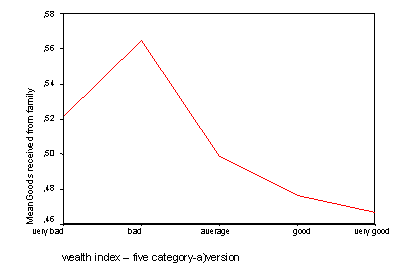
Table 2
Correlation between aid given to the family members
and wealth
(KSH/ Rate of living 2000/4. N=10785)
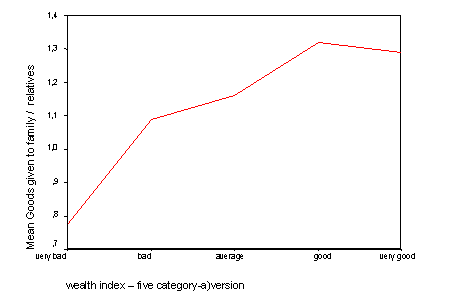
Table 3
Correlation between the intensity of given and/or
received solidarity actions of family members/ relatives and wealth
(KSH/ Rate of living 2000/4. N=10785)
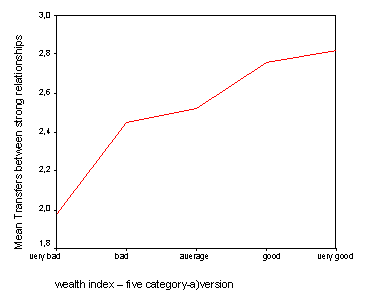
Table 4
Intensity of goods received from friends, neighbours
and colleagues considering wealth.
( KSH/ Rate of living 2000/4. N=10785)
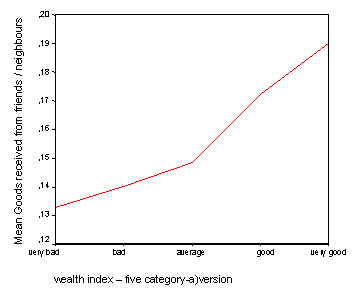
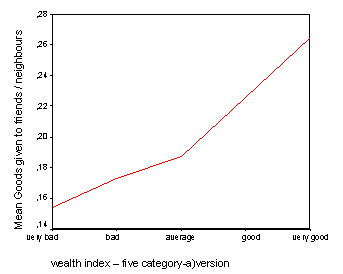
Table 5
Intensity of goods given to friends, neighbours and
colleagues considering wealth
( KSH/ Rate of living 2000/4. N=10785)
Family status of the
population over 15 years of age
In
1986 and 2000 (%)
( Samples: KSH/ Rate of living, 1986/4 N=9186, 2000/4 N=10549)
---------------------------------------------------------------------------------------------------------------
1986
2000
Difference
----------------------------------------------------------------------------------------------
Family status male female
total male female
total 2000-1986
------------------------------------------------------------------------------------------------
married
71,6 64,0 67,7 60,0 48,5
53,8 -13,9
-----------------------------------------------------------------------------------------------
spouseless 23,0 15,9
19,3 27,4 18,7
22,7 + 3,4
widow
/widower 1,8 14,0
8,2 4,9 21,6 13,9
+ 5,7
divorced/
live apart 3,6 6,0
4,8 7,7 11,2 9,6
+ 4,8
------------------------------------------------------------------------------------------------
single total 28,4 35,9
32,3 40,0 51,5 46,2
+13,9
------------------------------------------------------------------------------------------------
Partner relationships
(ISSP/2001 N=1524
over 18 years of age)
Singles without a stable
partner : 32.2%
Singles with a stable
partner : 9.1%
Lives with spouse/partner : 58.8%
------------------------------------------------------
Total
:100.0%
Rate
of people in different ages living without partner solidarity (spouse/partner in life/stable partner)
( TÁRKI, ISSP/ Social Networks / 2000,
N:1524, over 18 years of age)
Age Mean Male Female
twenties 24.6% 29.o% 19,6%
thirties 18.2% 21.4% 15.5%
fourties 20.8% 19.3% 21.9 %
fifties
25.3% 17.1% 31.6 %
sixties 40.7% 17.5% 57,3 %
seventies-X 57.5% 26.2% 74.0 %
------------------------------------------------------------------------------------------------ Living without a stable partner
32,2 % 21,9 % 40,1%
In case of
a minor disease, who would/could you ask help from?
( ISSP/ TÁRKI/ Social Networks 1986 N=926, 2001
N=1524, over 18 years of age)
----------------------------------------------------------------------------------------------
1986 2001
-----------------------------------------------------------------------------------------------
Spouse/partner
53,4 > 44,0
Mother 14,6 = 14,8
Father
1,1 0,9
Daughter 10,8 < 13,3
Daughter-in-law -- 0,8
Sun
4,4 < 8,7
Sun-in-law
-- 0,1
Sister
1,9 < 3,1
Brother
1,5 1,1
Other
relative
3,2 > 2,4
Spouse’s/partner’s relative -- 1,2
------------------------------------------------------------------------------------------------
Family/relatives total 90,9 = 90,4
------------------------------------------------------------------------------------------------
Friend
2,4 < 3,1
Neighbour
5,2 > 2,6
Colleague
0,1
0,1
Nurse
0,2
1,3
Paid help
0,4
0,1
Other
- 0,5
Nobody
0,8
1,9
------------------------------------------------------------------------------------------------
Total
100.0
100.0
------------------------------------------------------------------------------------------------
Who do you expect
financial aid from?
( ISSP/
TÁRKI/ Social Networks 1986 N=926, 2001 N=1524, over 18 years of age)
------------------------------------------------------------------------------------------------
1986
2001
------------------------------------------------------------------------------------------------
Spouse/partner
3,2 3,9
Mother
14,3 > 11,2
Father
4,4 > 3,6
Daughter
6,6 < 9,0
Son
4,1 < 6,5
Sister
2,3 4,3
Brother
3,2
2,7
Other relative
5,4
5,4
Spouse’s/partner’s relative -- 2,3
--------------------------------------------------------------------------------------------
Family/relatives total 43,5 48,9
-------------------------------------------------------------------------------------------
Friend
3,9
4,7
Neighbour
1,8
0,8
Colleague
0,2
0,5
Bank
42,3 > 22,5
Employer 1,7 1,1
Social institution
0,9
0,3
Private loan
---
0,1
Other
---
0,3
Nobody
5,7 < 20,8
----------------------------------------------------------------------------------------
Total
100.0
100.0
Who
would you discuss your sadness and sorrow with?
( ISSP/
TÁRKI/ Social Networks 1986 N=926, 2001 N=1524, over 18 years of age)
-----------------------------------------------------------------------------------------------
1986 2001
------------------------------------------------------------------------------------------------
Spouse/partner
43,0 > 40,7
Mother
9,5 > 6,0
Father
1,1 0,3
Daughter
4,5 < 9,0
Son 2,1 < 3,6
Sister
3,5 4,1
Brother
2,4 1,5
Other relative
1,7 2,5
Spouse’s/partner’s relative -- 0,3
------------------------------------------------------------------------------------------------
Family/relatives total 67,8 68.0
------------------------------------------------------------------------------------------------
Friend
14,5 14,6
Neighbour
3,4 3,4
Colleague
2,5 > 0,8
Priest
0,3 0,6
Family doctor
0,7 0,7
Psychiatrist, psychologist, therapist 0,2 0,6
Mutual-aid team
0,0 0,1
Other
0,2 0,7
Nobody 10,4 = 10,5
------------------------------------------------------------------------------------------------
Total
100.0 100.0
------------------------------------------------------------------------------------------------