Endre Sik
"SLAVE MARKET" IN MOSCOW SQUARE1
The "slave market" is the open-air marketplace form of
the informal labour market. People stand around at a street corner, at the edge
of a "Comecon marketplace" (Sik 1999), close to a major urban centre such as a
railway station, a park-and-ride site and wait to be hired for a day or at best
for a week. The typical jobs are low paid unskilled or semiskilled work on
construction sites or in agriculture.
In the Hungarian language the
traditional term for the "slave market" is the 'köpködõ'. The literal
translation of this term is 'spitting place'. This refers to the basic activity
while standing around for hours waiting for a job, i.e. smoking a pipe and as a
by-product spitting.
The closest example (though much smaller and
'local') I found to this marketplace form of informal labour allocation is
Tally's corner (Liebow 1967). This is a corner "in Washington's Second Precinct
... (where) two dozen Negro men share a corner ... as a base of their
operations. These men are unskilled construction workers, casual day laborers,
menial workers in retailing or in the service trades, or are unemployed ... on
the broad corner sidewalk ... some twenty men who live in the area regularly
come together for 'effortless sociability'"(p. 11 and p. 22)
As in 1995
and in 1997, in 1998 there was a "slave market" in about every fifth Hungarian
settlement2 While in 1995
and in 1997 the pub was the most frequent site of the "slave market", in 1998
the non-marketplace form of informal labour allocation (i.e. through personal
networks, mostly in close-knit groups) became the most widespread3 but the
importance of the various "slave market" sites did not disappear (Chart 1).
Chart 1. The spread of "slave market" sites and non-"slave market"
networks
in the Hungarian settlements in 1995, 1997 and 1998 (%)

Moscow
Square
We should begin the analysis with a brief introduction of
Moscow Square. In this I rely on a recently published excellent
historical-architectural-anthropological opus (Bodnár 1998). The author
summarises the major characteristics of the site of our "slave market" in the
following:
"Always a meeting point for different regions of the city,
this area developed at the end of the seventeenth century a clay pit that later
became the site of a brick-making factory... During World War II the square
evolved into one of the busiest traffic centers on the Buda side of the river
(Duna S.E.). In 1946 it was renamed Moscow Square ... In 1972 Moscow Square
found a new significance as a traffic center when a major subway station opened
there. This addition reinforced its role as the important last inner-city stop
for the steadily growing number of suburbanites residing in the Buda hills and
valleys."(p. 491).
To give the reader an opportunity to become familiar
with everyday life on the Moscow Square "slave market" I selected two recent
non-participant observations on the Moscow Square "slave market". The first is
again from Bodnár (1998) who used to live close to the square and therefore
despite the fact that - as she put it - "the bulk of the research was carried
out in the summer of 1995 ... the essay operates in an extended time frame, in
'postsocialist' time" (p. 492).
"The square rises early. Around 5.00
A.M. newspaper booths open, as the first subway trains, trams, and buses begin
running, and the main post office on the Buda side on the northwest perimeter of
Moscow Square unlocks its doors... By 6.30 there are about a hundred men smoking
and talking, waiting to be hired for a day or, if lucky, for more. Luck comes in
pickup trucks, transporting the freshly hired to small jobs at construction and
renovation sites, mainly villas for the new elite in the Buda hills... Employers
mostly offer jobs that do not require skills, but skilled laborers are in demand
too.
Most of the 'supply' at this brutally simple labor market comes
from abroad. M. is a good representative: a citizen of Romania and an ethnic
Magyar (Hungarian from abroad), he came to Hungary from Transylvania with his
neighbor. The two of them define themselves as jack-of-all-trades... When they
first came to Hungary four years ago, they were hired at Moscow Square for a
construction job in the Buda suburbs. They were passed on from one employer to
the other through the broad interpersonal networks of the family that first
employed them. They came in the spring, stayed until cold set in, then exchanged
the money they have saved for Romanian currency and returned to their village.
By the following spring, direct correspondence brought results, and they came
back to Budapest on the basis of a quasi-contract. Employers like them: they are
affordable, reliable, and quick...
Hungarians in the square call them
'smokey-faced' evoking the imagery of the racial slurs usually reserved for
'Gypsy', the only widely used, vigorous ethnic derogation in contemporary
Hungarian... Among the men gathering in search of work in Moscow Square recently
appeared some ethnic Romanians from Romania, as well as Magyars and Roma (Gypsy)
with varying citizenship, but Transylvanian Magyars still predominate. Common to
all of them is that they walk on a tightrope with the law. Hungarian citizens
violate tax regulations and the rules concerning unemployment compensation. The
others are undocumented, mostly seasonal, migrants... (pp. 492-494).
The
second snapshot is from 1998 and with the help of this brief overview we have a
look at Moscow Square through the eye of an American economic journalist (Reed
1998).
"It's another day on Moscow Square, Budapest's version of the
illegal urban labor markets in most big German cities. Hungary's surging economy
has become a magnet for illegal workers from down-at-heels countries farther
east - and for many of those seeking work, Moscow Square is the first stop.
Dániel, from the Romanian port city of Constanta, has been in Budapest
seven months, packed with four of his countrymen in a rented room since the
shipyard where he worked went belly up. József, a bricklayer from Satu Mare,
just across Hungary's eastern border, has been working the square for three
weeks without success. If money gets short, he says, he'll bed down in
Budapest's Keleti railway station. Living rough here is better than returning to
a country and hometown where the prospects for work are far bleaker. "I love
Romania, but it's impossible to live there," he says. "We have a rich country,
but the administration is bad."
(Moscow Suare is) a largely unpoliced
market where just about anything goes - and where few will supply a surname.
János, a 40-year-old ethnic Hungarian from the Transylvanian city of Sighisoara,
has nabbed just one piece of work since coming here in March: tearing down a
suburban garage. The contractor, a private construction company, promised him
13,500 forints ($64.28) for three days' work; in the end, the company paid János
just 1,000 forints. The former bricklayer owes 17,000 forints in back rent for
his room; until he finds enough cash to pay the tab, he says, he can't return
home to his wife and daughter.
If the living on Moscow Square is
anything but easy, it isn't hard to see why people like János keep coming.
Hungary's economy grew 4.4% in 1997, and is expected to grow by at least that
much again this year. Romania's economy contracted 6.5% last year, and it
continues to shrink. A worker in industry in Romania can expect to take home
about one million lei ($119) a month; in Budapest, he can earn the same amount
in about half the time, even at the cut-rate wages offered on Moscow Square.
Also keeping this market and others like it alive are employers in
construction, restaurants and other service industries, who turn to it to avoid
paying Hungary's West European-level social-security and other taxes, which can
add as much as 60% to wage costs. "If you get a Hungarian painter, he will ask
for a lot of money to paint a flat," says József, the bricklayer. "We will do it
for cheaper." (In fact, some of the job-seekers on Moscow Square are native
Hungarians who have fallen out of the labor market.)
Romanians, along
with Ukrainians and other inhabitants of the former Soviet Union, can stay in
Hungary visa-free for 30 days; when the visa runs out, the men of Moscow Square
say, they just hop a train to the border for a new stamp.
Short of
slamming shut Hungary's eastern borders, there isn't much Budapest can do about
illegal labor. Two police officers on Moscow Square checking for permits among a
group of Hungarian women selling flowers ignore the Romanians and Ukrainians
seeking work just a few paces away. Standing around isn't illegal, one of the
officers says; you have to catch them on the job.
By 4 p.m., the Moscow
Square men have thinned out to perhaps two dozen, lost in a surging rush-hour
crowd. One of them is János, the bricklayer looking to pay off his back rent. He
didn't pass muster with a construction-firm tout, who passed him over for
younger men. Nor was he offered anything by two Chinese men in the market for
help painting a house. Still, he figures he'll keep waiting around until day is
done. "Where else am I going to go?" he asks with an eloquent shrug. "I'll stay
as long as I need to get work". "
The non-participant observations we
did while preparing to do the research (Hideg-Grajczjar 1994) had very much the
same results as the two observations above. These observations were used to
develop the hypotheses of the research and fine-tune our special observation
technique (see next chapter). The hypotheses we wanted to test with our research
were as follows:
(1) - the 'opening hours' of the "slave market" are
short,
(2) - it is a seasonal marketplace with the peak of the demand
during the spring and summer,
(3) - the typical employer is either the
owner of a villa from the neighbouring elite suburbs (or their emissary) or
someone from the agglomeration of Budapest organising a work group mostly to do
agricultural or construction work,
(4) - the typical job is unskilled-
or semiskilled,
(5a) - the typical employee is ethnic Hungarian (and
neither ethnic Romanian nor Gypsy),
(5b) - but most of them come from
Romania (more precisely from Transylvania),
(5c) - against whom the
local employees are hostile since their presence decreases the average wage,
(5d) - the typical employee is also male and poor (often homeless),
(6) - the hourly wage is low and does not keep up with the inflation
rate.
Based on the almost constant flood of newspaper articles we assume
that (7) the "slave market" in Moscow Square is the major institution of the
allocation of unskilled labour in Budapest (if not all over Central Hungary).
The method
The method of the research was a
version of non-participant observation. The two young scholars who did the
pre-research observations (Gergely Hideg and István Grajczjar) were the
observers all year long. In the beginning there was some suspicion concerning
their presence (and that they made notes) but partly because they explained the
reasons for being there, partly because by the end of the first month the
employees realised that no harm came from their presence, and last but not least
since there is a constant flow of all sorts of observers (including not only the
rather tolerant police but several journalists) the actors of the "slave market"
(being rather tough and adventurous personalities anyway) are accustomed to
being in the open.
During the research period (between April 1995 and
March 1996) there were 84 observation periods distributed in a way that they
represented season, day and the three periods of a working day (dawn (around
6.00 a.m.), morning (around 8.00 a.m.), and forenoon (around 10.00 a.m.)
proportionally.
An observation period lasted for two hours and covered
the following tasks:
- In the beginning and end of the period the
observer made an estimate concerning the number of employees on the square, and
gave a general description of the context of the market, i.e. the weather
conditions and the presence of the police.
- On each occasion the
observer selected 20 employees (randomly, having a pre-selected part of the
square as starting point and going clockwise) and described their visible (or
audible) characteristics (clothing, ethnic origin, size of the group to which
they belong, age, gender, etc.).
- Observed as many bargaining
encounters as they could follow. They registered the first offer, the finally
agreed wage, the in-between offers, the non-pecuniary wage elements, the length
and place of the job, the visible (and audible) features of the employer, etc.
The basic characteristics of the "slave market"
A market place by definition should be public. As the two case
studies showed, Moscow Square spatially is open for the public. However, in case
of a market institution openness has a different meaning, i.e. the offers are
made public for several potentially interested actors. The "slave market" meets
with this requirement as well since 92 per cent of the offers were made in a way
that several employees (and groups of them) heard them and entered into
negotiation simultaneously. In average 13.3 employees listened to the offers.
Beyond being public spatially and as a market, the "slave market" is a
market institution with a high degree of freedom as well. This is true
again in two senses. On the one hand, being part of the informal economy, there
is no state or trade union, chamber or guild restrictions whatsoever to curtail
the freedom of the bargain (whether the issue is the level of wage, the working
conditions, the travel or non-pecuniary subsidies, the length of the job or the
sanction of failing to meet the mutually accepted terms of the non-written
contract). On the other hand, the "slave market" is free from any close and
continuous police surveillance. Police presence was observed in about half of
the observation periods but was characterised by the two observers as active
(walking around and asking for documents, sending or taking away the
undocumented migrants, etc.) only in every fifth period.
Finally,
regarding the typical type and regional distribution of work, the "slave
market" allocates mostly short-term casual jobs. 34 per cent of the observed
offers (N=158) were daily jobs and 13 per cent of them consisted only work for
less than a full day4. Two thirds of
the jobs offered were unskilled ones - the rest being semiskilled or skilled
jobs (mostly masonry) - and 63 per cent of the jobs were concentrated in
Budapest (the rest in the vicinity of Budapest).
The
demand
The crudest estimate of the volume of demand on the "slave
market" is the total number of offers, i.e. the number of all offers observed.
In average it was 3.6 per observation periods (N=84). Both the median and the
mode were significantly below the level of the average (2 and 0, respectively)
which shows that there was a big deviation in the number of offers per
observation period5. The more
proper estimate of the volume of demand is the effective demand, which covers
only those offers when there was at least one employee listening to the offer.
Table 1 The total and the effective demand by time periods
| |
Total demand |
Effective demand |
| Total |
3.6 |
2.9 |
| Spring |
3.7 |
3.2 |
| Summer |
5.6 |
4.5 |
| Autumn |
3.7 |
2.7 |
| Winter |
1.2 |
1.2 |
| Dawn |
6.9 |
5.8 |
| Morning |
3.4 |
2.5 |
| Forenoon |
0.7 |
0.5 |
| Working day |
3.9 |
3.2 |
| Weekend |
3.1 |
2.5 |
The demand for casual
labour is the highest in the summer and at dawn and the lowest in winter and in
the forenoon. There is not much difference between the distribution of the total
and effective demand which implies that the unsuccessful offers are not
concentrated into any particular time period.
As to the joint effect of
the three time periods on the volume of total and effective demand (Table 2) we
find that while the period of the day and the season have a significant role,
the day (or part of the week) does not influence the volume of demand.
Table 2 The determinants of total and effective demand (OLS
regression6)
| |
Total demand
(R2 =
0.52) |
Effective demand
(R2 =
0.48) |
| Dawn |
6.16 (0.70) xxx |
5.3 (0.71) xxx |
| Summer |
3.37 (0.36) xxx |
2.6 (0.33) xx |
| Morning |
2.29 (0.26) xx |
1.9 (0.25) xx |
| POLICE |
- 1.64 (-0.19) x |
- |
| GOODWEA |
1.61 (0.19) x |
- |
xxx = T-value significant
on 0.0001 or below.
xx = T-value significant between 0.001 and
0.0002.
x = T-value significant between 0.05 and 0.002.
POLICE: dummy, 1= active policing.
GOODWEA: dummy, 1= good weather.
Both the total and the effective demand is higher at dawn. To hire a
casual labourer (and to be hired) at dawn gives the maximum utility for both
actors (a full day's work on the site for the employer and a full day's wage for
the employee).
Table 2 shows also the role of the two major contextual
factors of "slave market" transactions. We assumed that the better the weather
(the more work can be done both on construction sites and in agriculture) and
the less strong the police presence (less danger of being caught in an illegal
action), the higher is the demand.
In the case of total demand both
hypotheses were confirmed. However, in the case of effective demand the
influence of the weather and policing conditions disappears. This might indicate
that when there is strong demand and the negotiation is already on, it does not
matter whether the weather is good or bad and there is police around, the show
must go on.
The supply
There are two measures
to estimate the volume of supply. The term total supply refers to the total
number of potential employees (those standing around the square during a
two-hour observation period) while the effective supply is equal to the number
of potential employees who listened to the offers observed.
The average
volume of total supply per hour is 58 persons7. It is
significantly higher in the spring, at dawn and in the morning (73, 78, 78
persons, respectively), and significantly lower in winter and in the forenoon
(36 and 18 persons, respectively). There is no significant difference between
the level of demand on working days and in the weekend.
Table 3 shows
the joint effect of time periods on the level of supply. As it was the case with
the level of demand, it is the period of the day and the season which have the
strongest influence on the volume of both the total and the effective supply.
Table 3 The determinants of total and effective supply (OLS
regression8)
| |
Total supply
(R2 =
0.47) |
Effective supply
(R2 =
0.10) |
| Dawn |
120 (0.65) xxx |
7.7 (0.37) x |
| Morning |
120 (0.65) xxx |
|
| Spring |
66 (0.32) x |
5.4 (0.24) x |
| Summer |
51 (0.26) x |
|
| Ethnic Romanian |
|
3.7 (0.18) x |
| Weekend |
|
3.6 (0.18) x |
xxx
= T-value significant on 0.0001 or below.
x = T-value
significant between 0.05 and 0.002.
The volume of total supply strongly
increases at dawn and in the morning and in the spring and summer. The volume of
effective supply is also higher at dawn and in the summer but the weekend and
the presence of ethnic Romanians also slightly increase its size. We can
conceptualise the morning and spring periods as 'extensions' of the peak periods
(dawn and summer) i.e. when the effectives supply is the highest. The fact the
weekend and the presence of foreign employees increase the volume of supply fit
well to our hypotheses.
As to the demographic composition of the supply,
95 per cent of the observed casual labourers (N=1290) were male, and two thirds
of them were in their twenties or thirties.
Concerning ethnicity and
citizenship, the two major groups (36 per cent each) were ethnic Hungarians from
Hungary and ethnic Romanians from Romania. The proportion of ethnic Hungarians
from Romania was only about 10 per cent, and of Gypsies about 16 per cent (the
rest being unknown).
As to the economic conditions of the casual
labourers, more than half of them wore "normal" clothing (fitting to the
everyday composition of the urban male population), and only about 8 per cent of
them wore 'poor clothing' i.e. rags.
The "slave market" is composed of
several small groups. 27 per cent of the casual workers were standing around in
pairs, 38 per cent of them in groups consisting of three or four persons and
only 21 per cent of them were singles.
Finally, the socio-economic
characteristics of both demand and supply differ slightly between the skilled
and unskilled offers and workers. (Table 4)
Table 4 The major
characteristics of the skilled and unskilled workers and offers
| |
Skilled offers |
Unskilled offers |
| N |
45 |
135 |
| Total demand (average) |
11 |
14 |
| Bargain has begun (% of all offers) |
59 |
51 |
| Number of employed (average) |
1.7 |
2.6 |
| Length of job (average) |
5.2 |
5.2 |
| Wage first offered(HUF) |
1935 |
1329 |
| Wage first asked (HUF) |
2362 |
1711 |
| Wage agreed (HUF) |
1985 |
1452 |
| WAGEWAR (average) |
1.31 |
1.29 |
| WAGEWIN (average) |
1.09 |
1.08 |
| Job in Budapest (% of all jobs) |
72 |
56 |
| Organized by a recruiter (%) |
11 |
24 |
| Employee is Gypsy (%) |
6 |
16 |
| Employee is ethnic Hungarian (%) |
45 |
27 |
| Employee is ethnic Romanian (%) |
17 |
31 |
WAGEWIN = Wage accepted/Wage first
offered.
WAGEWAR= Wage first asked/Wage first offered.
Both the
total demand and the number of hired employees is higher among the unskilled
than among the skilled workers but the latter group is more likely to enter into
negotiations. These associations might mean that while the "slave market" is
dominated by unskilled offers and employees, the smaller skilled segment is the
more competitive. This evaluation is reinforced by the slightly higher value of
WAGEWAR (explanation see below Table 5) and the more individualistic nature of
the bargain (the proportion of professional recruiters is lower).
The
wage level is significantly higher in the skilled segment compared to the
unskilled one. This is a result of the differences of the amount of human
capital and productivity of the two groups. However, this difference might also
be connected to the differences in the regional distribution of the jobs
(Budapest has higher wages in all labour market segments and the unskilled
labour is more concentrated to this local labour market) and social composition
of the employees. As to this latter association, among the unskilled workers the
Gypsies and the ethnic Romanians, among the skilled workers the ethnic
Hungarians from abroad are overrepresented.
Equilibrium
and wage on the "slave market"
There are various ways of estimating
the level of success of the "slave market". One option is to estimate the number
of successful contracts, i.e. the number of bargains which terminated in an
agreement. In average three successful contracts were made per hour (six per
observation period). This means that on an average market day (between 6.00 a.m.
and noon) 18 contracts were concluded. The problem with this figure is that we
cannot compare it to any other result since the 'real' labour market (controlled
for region, type of job and branch) has no identical measures and there is no
similar research of "slave markets" in the literature.
Another option is
to estimate the level of success of the market by the number of employees who
were hired compared to the volume of the total supply. In average there were 2.5
employees hired in a successful contract. Multiplying this figure with the daily
number of successful contracts we arrive at the estimate of 45 employees hired
on an average day. This is about 10 per cent of the total average daily supply
(about 120 potential employees were observed in one observation period). One of
ten employees hired does not seem to us a very successful market, though we
again have no comparative data of the 'real' labour market or any other "slave
market".
Finally, the level of success of the bargains themselves was
definitely high, 86 per cent of the bargains terminated in an agreement. This
clearly shows that on a "slave market" the aim of both parties involved in the
negotiations is to reach an agreement.
However,
there must be the proper amount of demand and supply to get a good chance to
have a successful negotiation. In other words, a marketplace should have a
quasi-equilibrium between the volume of demand and supply. Chart 2 contains a
crude proxy to estimate the equilibrium of demand and supply.
Chart 2
The equilibrium of supply and demand by time periods
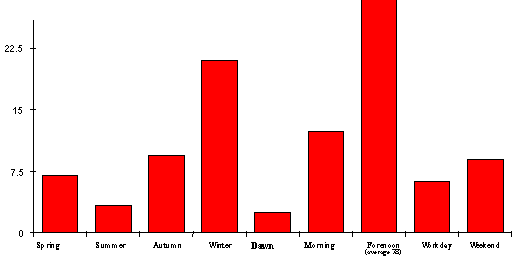
The proxy was computed as
follows: we divided the total supply (number of potential employees observed) by
the number of potential jobs (number of effective offers multiplied with the
number of hired employees). If the proxy is close to 1.0 than there is
equilibrium on the "slave market", if it is bigger than 1.0 there is slack
labour, if lower than 1.0 there is labour shortage on the "slave market".
In the total sample (N=84) the average of the proxy was 7.46. This shows
that the normal situation on the "slave market" is the oversupply of labour.
Whether this figure is just similar to the supply/demand relation on the 'real'
labour market or on other "slave markets" we again do not know. As to time
periods, at dawn and in the summer the labour oversupply is much lower, in the
forenoon and in winter much higher than in general.
Beside the level of
success and of the equilibrium between demand and supply, the most crucial
characteristic of a labour market is the wage level. It is not by chance that
when there was any bargaining (53 per cent of all offers), in three fourths of
the cases the wage was the only issue of the bargain. Table 5 shows the basic
characteristics of the wage bargain process.
Table 5 The basic
characteristics of wage bargain on the "slave market"
| |
Wage first offered |
Wage first asked |
Wage agreed |
WAGEWIN |
WAGEWAR |
Wage first offered
(in case
bargaining) |
Wage first asked
(in case
bargaining) |
| N |
185 |
78 |
70 |
70 |
76 |
78 |
70 |
| Average |
1486 |
1873 |
1571 |
1.12 |
1.3 |
1447 |
1882 |
| Median |
1300 |
1600 |
1500 |
1.07 |
1.3 |
1300 |
1600 |
| Mode |
1200 |
1500 |
1500 |
1.00 |
1.3 |
1200 |
1500 |
WAGEWIN = Wage accepted/Wage
first offered.
WAGEWAR= Wage first asked/Wage first offered.
The
wage first asked was about 30 per cent higher than the wage first
offered9. The ultimate
issue of the bargain was what the finally accepted level of wage would be. To
analyse the process of bargaining we should exclude those cases where there was
no bargain. However, if we compare the average wage first offered and asked in
general to those in the cases where there was bargaining (last two columns,
respectively) we see no significant difference. In other words, in the opening
phase of the bargaining process the starting offers and expectations do not
deviate from the general wage level. This shows that both bargainers and those
who do not bargain have similar knowledge and attitudes.
Due to the
bargain the finally accepted level of wage is between the first offered and
first asked wages but much closer to the first offered wage. This on the one
hand shows that from the employee's point of view it made sense to enter into
bargaining, on the other hand the result is clearly in favour of the employer
which shows the power relations and the role of oversupply on the "slave
market".
The difference between the median and modal wages first offered
and first asked is about the same as in the case of the average but the median
and modal wage accepted is closer to the wage asked than to the wage offered.
This means that a large proportion of employees are able to strike a good
bargain while a smaller subset of them are real losers.
Restricting our
analysis to those cases where there was bargaining, the WAGEWAR variable shows
that the average wage asked is about one third higher than the average wage
first offered. Since the median and modal WAGEWAR values are similar to those of
the average we assume that in this respect there are no major differences among
the employees.
From the fact that the value of WAGEWIN is lower than
that of the WAGEWAR, we can conclude that while on average there is a 10 per
cent increase of the average wage due to successful bargaining, this remains
below the original expectations of the employees. The median and mode being
close to one shows again that for large groups there is even less gain in the
course of bargaining, and in consequence a small group has larger gain from it.
In Table 6 we find the determinants of the level of wage in the Moscow
Square "slave market".
Table 6 The determinants of the wage and
process of wage bargain (OLS10)
| |
Wage first offered (R2=25%) |
Wage first asked (R2=17%) |
Wage accepted
(R2=28%) |
WAGEWIN
(R2=18%) |
WAGEWAR
(R2=6%) |
| Unskilled labour |
-392(-0.36) xxx |
-479(-0.34) xxx |
-429(-0.44) xxx |
|
|
| Length of job |
|
-17 (-0.27) x |
-12 (-0.26) x |
|
-0.01 (-0.29) x |
| Autumn |
-253(-0.24) x |
|
|
|
-0.13(-0.30) x |
| Summer |
-222(-0.23) x |
|
|
|
|
| Spring |
|
|
|
-0.12(-0.36) x |
|
| Morning |
-531(-0.36) x |
|
|
|
|
| Dawn |
-436(-0.44) x |
|
|
|
|
| Gypsy |
|
|
|
|
0.13(0.30) x |
| Ethnic Romanian |
|
|
-347 (-0.39) xx |
-0.12(-0.42) xx |
|
| Job in Budapest |
|
|
|
-0.08(0.29) x |
|
xxx = T-value significant on
0.0001 or below.
xx = T-value significant between 0.001 and
0.0002.
x = T-value significant between 0.05 and 0.002.
To begin with the three elements of the bargaining process (first three
columns in Table 6), to be unskilled decreases the wage offered, asked and
accepted alike. This clearly shows not only that the value of human capital (as
a proxy for productivity) associates negatively with the level of education but
that this fact is known to both actors of the labour market.
The length
of the job has no influence on the wage first offered but has a low negative
impact on the wage asked and accepted. This is a sign that casual employees are
ready to ask a lower hourly wage if they can get a longer job and vice versa.
This shows the rationality of casual labour, i.e. the maximum amount of income
can be achieved if the employee can find the proper pay-off between hourly wage
and job length. (Sik 1986/7) To try to maximise both would very likely result in
not being hired.
Time periods influence only the level of wage first
offered. In winter and in the forenoon the wage first offered is higher than at
any other time. This is partly due to the fact that these are the periods with
the lowest amount of offers but paradoxically also the periods when the
oversupply is the highest. Very likely these offers are 'deviant cases', i.e.
for a small sample of skilled workers to do urgent (indoor) jobs.
Finally, to be ethnic Romanian does not influence the level of wage
first offered (i.e. no discrimination on behalf of the employer) but
significantly decreases the accepted wage level. This might be a sign of the bad
bargaining resources of ethnic Romanians (lack of proper Hungarian language,
unsuccessful bargaining strategy).
As to the two summarising bargaining
proxies (last two columns in Table 6), three factors decrease WAGEWIN: to be
ethnic Romanian, to have the job in Budapest and in the spring. The first
influence has already been mentioned, the latter two show that the more offers
there are the more difficult it is to strike a good bargain.
The
boldness at the beginning of the bargaining process (WAGEWAR) is decreased by
the length of the job and by the autumn. The first impact is again related to
the rationality of the employees (not to begin the wage fight high if there is a
chance to get a longer job). The latter might be a sign that in the autumn the
employee becomes more cautious about making a high first bid.
Gypsy
origin increases the boldness at the beginning of the bargaining process. This
could be a culture-specific bargaining practice (to begin the bargain with a
high bid) and/or could be the result of discrimination (the first offer is
extremely low to discourage the potential employee from continuing to bargain).
However, neither of the previous alternative but non-exclusive explanations can
be true since neither the wage first asked nor the one first offered was
decreased by the Gypsy origin.
Summary
Most of
the hypotheses we developed as a result of the pre-research fieldwork and of the
case studies were proven by the year-long non-participant observation research.
Most of the transactions of the "slave market" take place before 10 a.m. and the
peak hours are before 7 a.m. (hypothesis 1), the "slave market" is seasonal with
the peak months in the spring and summer (hypothesis 2), it is concentrated in
Budapest and its vicinity (hypothesis 3). The typical jobs on the "slave market"
are casual unskilled job in construction (hypothesis 4) and the typical employee
is a male (hypothesis 5d) from Romania (hypothesis 5b) who has a low wage
(hypothesis 6).
However, there are some features of the Moscow Square
"slave market" which differ from what the case studies (and public stereotypes)
suggested.
First, though there is a substantial number of ethnic
Hungarians from Transylvania among the employees, the dominant groups are
'Hungarian Hungarians' and ethnic Romanians from Romania (see hypothesis 5a). I
guess the reason for misjudging the ethnic composition of the employees is
rooted in the history of the Moscow Square "slave market". Very likely in the
beginning ethnic Hungarians from Transylvania were in fact the dominant group of
employees. However their share has decreased partly since they became familiar
with the Hungarian labour market in general and proved to be good workers and
therefore by 1995 could afford to avoid the "slave market". Another explanation
may be that by 1995 the Romanian temporary migration was dominated by ethnic
Romanians who followed the tracks of their Hungarian forerunners. Finally,
impoverishment and lasting unemployment in Hungary gave incentives to the
Hungarians to show up on the "slave market".
Secondly, contrary to what
hypothesis 5c suggests, not every ethnic group of migrant labour has lower wages
than those of locals. Only the Romanian ethnicity (and in a special form the
Gypsies) has a wage disadvantage on the "slave market".
Last but not
least, despite what the media and common sense suggest, the Moscow Square "slave
market" is far from being the major institution of allocation on the Budapest
(let alone the Central Hungarian) labour market (hypothesis 7). Even labour
market specialists were surprised when they learnt that on an average day there
are no more than about 20 successful transactions in Moscow Square and the total
number of employees is below 300 persons between 6.00 and noon. While the Moscow
Square "slave market" is definitely very important in offering casual jobs for a
certain type of local and migrant low educated and unemployed stratum and in
serving as a convenient market for the building contractors from North Buda and
from the vicinity of Budapest, its visibility (due to its spatial situation and
media coverage) is far greater than its real importance.
References
Bertalan, Béláné (1997), 'Fekete munka
importból?' (Black labour - imported?) In: Migráció és politika Eds.:
Sik, Endre and Tóth, Judit, MTA PTI, Budapest, 121-134.
Bodnár, Judit
(1998), 'Assembling the Square: Social Transformation in Public Space and the en
Mirage of the Second Economy in Postsocialist Budapest', Slavic Review,
57, No. 3 (Fall), 9-515.
Hárs, Ágnes (1992), 'Vendégmunkások
Magyarországon'. (Guest labourers in Hungary). In: (Ed.) Sik, Endre:
Menekülõk, vándorlók, szerencsét próbálók. MTA PTI, Budapest, 33-48.
Hideg, Gergely-Grajczjar, István (1994), A Moszkva téri emberpiac
(The "slave market" of Moscow Square), Manuscript, Budapest.
Hunyadi,
Zsuzsa (1992), 'Vendégmunkások Erdélybõl" (Guest workers from Transylvania) In:
(Ed.) Sik, Endre: Menekülõk, vándorlók, szerencsét próbálók. MTA PTI,
Budapest, 23-32.
Katona, Imre (1956), 'A baráber', (The wandering
labourer) Ethnográfia 1-2: 13-26.
Katona, Imre (1961),
'Munkaszervezeti formák és ideiglenes életközösségek idénymunkákon a
kapitalizmus korában.' (Forms of labour organisation and temporary co-existences
at seasonal work in the age of capitalism). Agrártörténeti Szemle Nos.
3-4, 534-563.
Liebow, Elliot (1967), Tally's Corner Little Brown,
and Company, Boston
Reed, John (1998), 'Hungary's Economy Lures Illegal
Labor From the East,' The Wall Street Journal Europe, April 27.
Sik, Endre (1986/7), 'A casual labour market', Angewandte
Sozialforschung, Jg. 14, No. 1: 63-71.
Sik, Endre (1995), 'The
Methodology of the Informal Market Research.' ILO/Japan Working Paper
Series, No. 1., Manuscript, Budapest.
Sik, Endre (1998), 'Bérek a
feketemunka piacán'. (Wages in the market of black labour). In: 50 éves a
BKE, BKE, Budapest, 133-149.
Sik, Endre (1999), Open air markets in
contemporary Hungary, International Journal of Urban and Regional
Research, forthcoming.
Notes
1. The research was commissioned by the ILO/Japan Project and
ICCR-Budapest. The first Hungarian version of the paper was written while I was
a Visiting Mellon Fellow at the Institute for Human Sciences (Vienna).
2. As to the source of data, in 1995, in 1997 and in 1998
we interviewed all the mayors (or a representative of the municipality) of the
approx. 3100 Hungarian settlements, asking if there were informal market(s) in
their settlement. We supposed that local authorities must have fresh and
reliable information concerning the existence and (if there is any) the activity
of informal markets within the boundaries of their settlements. The
self-administered questionnaire sought only the basic information on the number
and composition of the "slave markets". We got approximately 800, 1200 and 1100
answers in 1995, 1997 and 1998 respectively. The data was weighted by location
(six territorial units of Hungary, Budapest excluded), size and status (county
capital, city or village) using the HCSO settlement data from 1995 (more
detailed information of the data and the questionnaire can be found in Sik
1995).
3. As it was also the case traditionally in major
construction work (such as roads) and for certain seasonal agricultural work
such as harvesting (Katona 1956, 1961) and even for urban construction and
intensive agricultural cultivation in recent times (Hunyadi 1992; Hárs 1992;
Bertalanné 1997)
4. The longest job offered was a
harvesting job for two weeks, and 10% of all offers covered jobs for at least
ten days.
5. While in 38 per cent of all observation
periods there was no offer at all, the maximum number of offers was 16.
6. The first number is the B-value, the second (in
brackets) is the beta-value.
7. Both the mode and the
median are significantly lower than the average (10 and 38 respectively). All
variables are dummies.
8. The first number is the
B-value, the second (in brackets) is the beta-value.
9.
The difference between skilled and unskilled labour can give us a hint as to
what extent the wages we observed on the Moscow Square "slave market" fit to the
wage level in general. In Table 4 we saw that the wage first offered for skilled
labour is about one third higher than that for unskilled labour. Figures of the
National Labour Market Service show that in 1998 the wage level of masons was
about double that of unskilled construction workers and two and half times
higher than that of agricultural unskilled labourers.(Sik 1998)
10. The first number is the B-value the second (in brackets) is the
beta-value. All variables are dummies, except the length of job which is equal
to the number of days offered.